How the Expansion of Megacities Will Boost Metal Markets
June 11, 2024

How the Expansion of Megacities Will Boost Metal Markets


Urbanization drives metal demand, and megacities are leading the drive.


As developing economies grow, millions of people are moving to cities to pursue opportunities compounded by proximity and availability to resources. Many of these people see their economic circumstances improve, and consumption increases as a result.


Cars get more numerous, electricity and public transport networks expand, and consumers buy more electronic products for their homes. All of this means more steel, more copper, more aluminum, and more cement are needed.

The rise of China’s megacities in recent decades embodies this growth of living standards and demand for resources. By 2035, Oxford Economics forecasts that Asian cities as a group will be richer than European and North American cities combined, with six Chinese cities on the list of the 10 richest cities globally: Beijing, Chongqing, Guangzhou, Shanghai, Shenzhen, and Tianjin.


By 2035 these six cities are expected to double their wealth, while global average income per capita is expected to increase by only 37% during the same period.


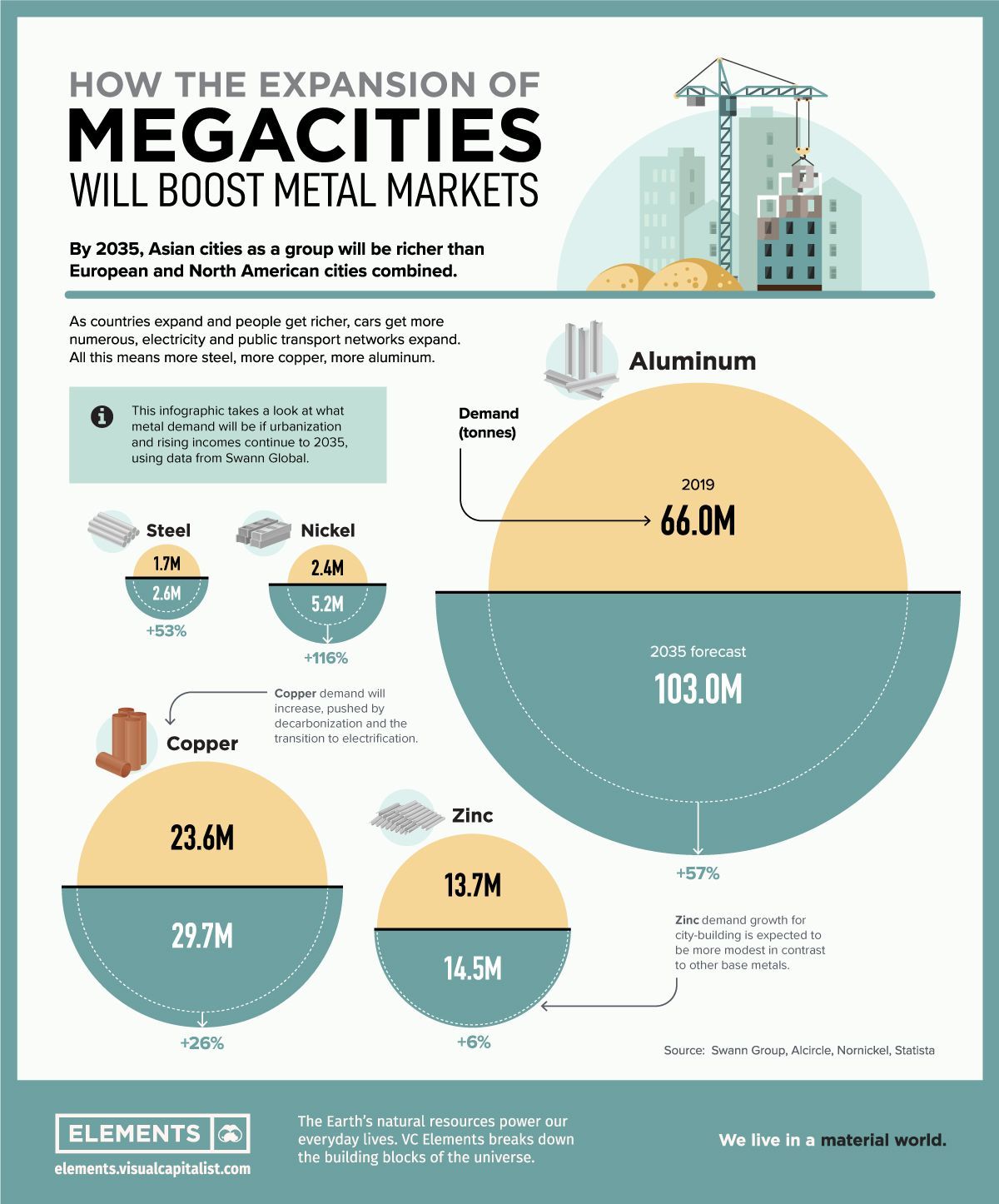
This infographic, based on research from Swann, takes a look at how the growth of megacities will drive metal demand well into the future.


Megacities Metal Megatrend: Growth in Demand to 2035


The Swann Index measures the intensity of use of each metal by looking at global consumption in tonnes between 2014 and 2019, dividing by GDP per capita, and then forecasting demand up until 2035. Here are some key materials and how they are expected to fare:

Metal Demand (tonnes, 2019) Demand (tonnes, 2035) Change (2019–2035)
Nickel 2.4 5.2 116%
Steel 1.7 2.6 50%
Aluminum 66.0 103.6 57%
Copper 23.6 29.7 26%
Zinc 13.7 14.5 6%

Nickel demand is forecast to increase by 116%, from 2.4 million tonnes in 2019 to 5.2 million tonnes in 2035. The drive is fueled by consumer goods, batteries, and high-value new applications, such as super alloys and stainless steel.


Aluminum and steel are also expected to see significant growth of 57% and 50%, respectively. Aluminum’s growth will be particularly noticeable due to the market size, with an expected demand of 103.6 million tonnes in 2035.


Copper’s demand growth will largely be pushed by decarbonization and the transition to electrification and automated technology. The metal is expected to see demand increase by 26% to 29.7 million tonnes in 2035.


In comparison, zinc is likely to underperform other base metals, with an estimated increase of only 6%. This modest growth reflects strong competition from aluminum in some end-use markets such as diecast alloys.


Future Megacities on the African Horizon


Though megacity demand for metals is being driven largely by Asian growth in 2020, the focus will likely shift in the coming decades.


Projections of future population growth and the world’s biggest cities all point to Africa as the next leader in growth, and subsequently, demand. Estimates show that 17 of the 20 fastest growing cities from 2020 to 2025 are located in Africa.


By 2100, the world’s three largest cities with populations greater than 70 million are projected to be in Africa, with Nigeria’s Lagos leading the way. In fact, of the world’s 20 largest projected megacities, 13 will be in Africa and zero will be located in China.


For now, Asian and primarily Chinese cities are leading demand for urbanization materials and already putting a strain on some metals. Even though the future megacity landscape might change, the expected continued increase in economic growth and incomes will continue to drive metal demand.


Copyright © 2024 Visual Capitalist
November 18, 2025
TORONTO, Nov. 18, 2025 - VVC Exploration Corporation, dba VVC Resources ("VVC" or the "Company") (TSX-V: VVC; OTC: VVCVF) announces that, after a project review, it has strategically restructured its mining projects in Mexico. This project review encompassed multiple considerations, including ongoing maintenance costs, permitting authorizations, political climate, safety, upside potential and financeability of each project and probability of achieving the projects potential. After this review, the Company has decided to: Exit the Gloria Copper Project located near Samalayuca, State of Chihuahua, Mexico. This long-standing project of the Company is expensive to maintain and is in an area that has become more politically volatile with uncertain safety. The geological potential of the project is not in question, but the ability to achieve that potential is unclear. Focus all mining exploration activity on the Cumeral Gold Project. Cumeral is the Company’s highly prospective gold project in north central Sonora Mexico. This project, while not as advanced as the Gloria Copper Project, has a huge upside potential. It is in an area where there is strong local support for the project and a higher likelihood of permitting and implementation success. The Cumeral Gold Project is a 1,665-hectare property in northern Sonora near Imuris which exhibits quartz-vein–hosted gold in a detachment-fault/orogenic setting with a documented NNW–SSE mineralized trend of ~4 km. Historical work reported that ~36% of 407 grab/chip samples assayed 0.1–10 g/t Au; soil surveys outlined additional anomalies (47 samples >0.020 ppm Au); and air-track drilling intersected broad, near-surface intervals of 0.21–0.44 g/t Au over 6–26 m in key target areas. The Company will continue activities on the Cumeral Gold Project. Rationale and Next Steps The Company’s decision reflects consideration of cost discipline, safety and risk management. The exit from the Gloria Copper Project will reduce future cash outlays for care, maintenance, and permitting at amid uncertainty over permit viability and broader political conditions in Chihuahua State. Capital and management resources will be reallocated to the Cumeral Gold Project exploration, and to development of the Company’s helium/natural gas project in the Central Kansas Uplift (CKU) Project where existing infrastructure and near-term activities offer a clearer path to execution. « There are opportunity costs in every project, » said Jim Culver, CEO. « Exiting the Gloria Copper Project will allow the Company to concentrate resources on projects with an obvious direct and timely route to advancing development while maintaining discipline on risk and spending. » About VVC Resources VVC engages in the exploration, development, and management of natural resources - specializing in scarce and increasingly valuable materials needed to meet the growing, high-tech demands of industries such as manufacturing, technology, medicine, space travel, and the expanding green economy. Our portfolio includes a diverse set of multi-asset high-growth projects, comprising: Helium & industrial gas production in western U.S.; Gold & associated metals operations in northern Mexico; and Strategic investments in carbon sequestration and other green energy technologies. VVC is a Canada-based, publicly-traded company on the TSXV (TSX-V:VVC). To learn more, visit our website at: www.vvcresources.com. Neither TSX Venture Exchange nor its Regulation Services Provider (as that term is defined in policies of the TSX Venture Exchange) accepts responsibility for the adequacy or accuracy of this release. 
h
October 9, 2025
TORONTO, Oct. 09, 2025 - VVC Exploration Corporation, dba VVC Resources ("VVC" or the "Company") (TSX-V: VVC; OTC: VVCVF) announces that Plateau Helium Corporation ("PHC"), a wholly owned subsidiary of the Company, has completed the purchase of the Ithaca 1-17 well together with approximately five miles of associated pipeline located in Rush county, Kansas in a prolific helium, gas and oil area known as the Central Kansas Uplift (CKU). The acquisition was initiated in April 2025 and PHC took possession in July 2025. As previously disclosed in our May 30, June 26 and September 2025 MD&As, PHC has a 50% operating interest in the well. The CKU Project targets helium-rich natural gas within multiple stacked reservoirs in Rush and Pawnee Counties, Kansas, where PHC has now assembled a meaningful lease position, acquired one producing property (Ithaca 1-17) and associated gas gathering system, and identified multiple development well locations. The acquisition of an existing gas gathering system serves to lower initial development cost while expediting the time needed to commence gas/helium sales and provide cashflow. « Building on a producing asset while securing midstream capacity is a practical way to de-risk our development program in the CKU, » said Bill Kerrigan, President of VVC and PHC. « The Ithaca 1-17 well and pipeline give us a backbone to bring wells online more efficiently. » About VVC Resources VVC engages in the exploration, development, and management of natural resources - specializing in scarce and increasingly valuable materials needed to meet the growing, high-tech demands of industries such as manufacturing, technology, medicine, space travel, and the expanding green economy. Our portfolio includes a diverse set of multi-asset, high-growth projects, comprising: Helium & industrial gas production in western U.S.; Gold & associated metals operations in northern Mexico; and Strategic investments in carbon sequestration and other green energy technologies. VVC is a Canada-based, publicly-traded company on the TSXV (TSX-V:VVC). To learn more, visit our website at: www.vvcresources.com.  Neither TSX Venture Exchange nor its Regulation Services Provider (as that term is defined in policies of the TSX Venture Exchange) accepts responsibility for the adequacy or accuracy of this release.
Show More >